Homestead Resilience
posted on
February 25, 2026
One of our cows, Violet, calved last Wednesday night. We decided not to keep this calf, as it was a bull, so we sold it to a friend.

All was going well - until I went out to milk Friday morning.
I walked outside and found her lying on her side - completely helpless in the bitter cold. It looked like she had been lying there for a while and was fading fast.
I had an intuition that it was milk fever - but was not sure. Milk fever (scientifically known as post parturient hypocalcemia or parturient paresis) occurs when there is a significant drop in calcium in a cow’s blood. This is caused from a cow struggling to get enough calcium from their bones and diet to meet the increased demand from their milk coming in after calving. Older dairy cows are the most susceptible to milk fever.
I checked with a couple of the closest vets and none of them were able to come out. Knowing that the cow’s metabolism was already going down, I knew that we needed to get calcium into the cow’s blood ASAP to save her.
My brother-in-law Philip assisted us in getting the supplies we needed to administer a calcium IV and then patiently walked us through the process on a video call. I have never given a shot - much less hooked in a large needle for an IV - but when you have no options, you do what you have to do.

It really is a little unnerving to insert a needle into a cow’s jugular vein, but it went well. After the IV, she definitely was starting to get more responsive, but still seemed very weak, so we ended up giving her a second IV a couple hours later.
We tried to get her up multiple times during the day, but she still didn’t have enough strength. I was worried that if we couldn’t get her up before nightfall, she would not make it through the night outside of the barn.
It was getting later into the evening, and she was getting stronger, and would try to get up, but was still not able to. A farmer friend offered to come over and help her get up using a skid steer. As he drove around the barn, we saw that she had just gotten up herself and was trembling all over from the exertion.
We got her into the barn for the night, making sure she was supplied with molasses, water, and hay. Over the next couple of days, she slowly became more energetic and back to her old self. She is now fully recovered and doing well.
With her milk supply, we have plenty of our raw A2A2 milk available again!
This is the time to set-up or increase your subscription and let your friends and family know!
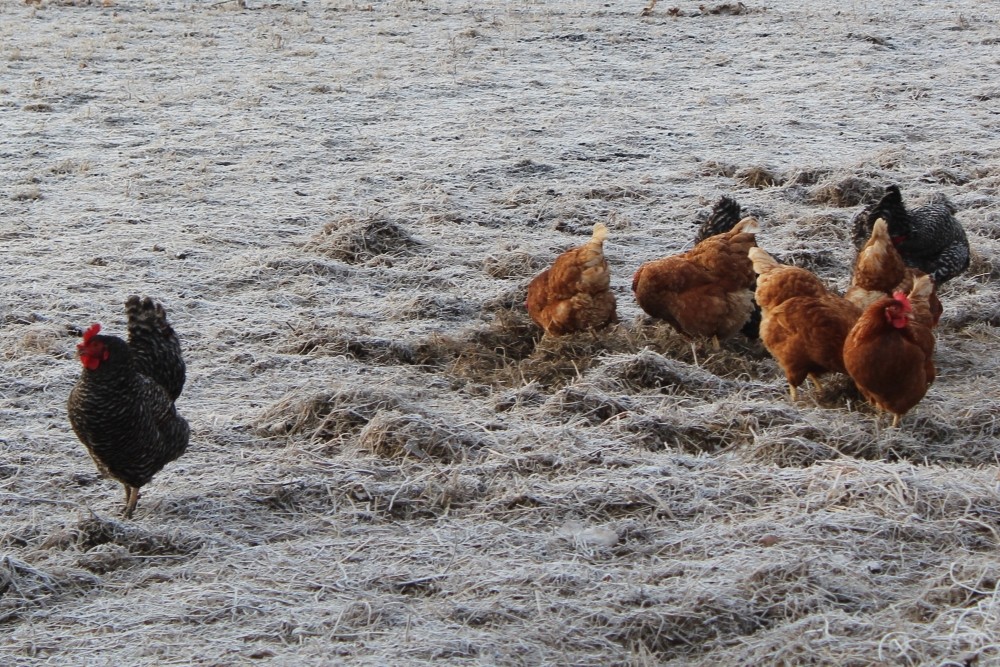
If you have driven by our farm lately, you probably have seen the chickens wandering around the pasture. We have let them outside of the poly fence (actually - the cows decided to let the chickens out by repeatedly knocking over the poly fence). Anyway, it has been working out pretty well for the chickens to have free access to the whole pasture (as we added another wire to the perimeter fence to help keep them in).
Chickens are scavengers and do an excellent job at sanitizing behind cattle by spreading out their cow pies. Our chickens have roughly 1000x more space per bird than the minimum requirement for commercial free-range chickens! Is that even apples-to-apples anymore?
Our farm-fresh eggs are soy, antibiotic, and vaccine free and fed organically raised non-GMO feed (including a special variety corn which has higher protein and essential amino acids than normal corn). We also have un-washed eggs available!
We appreciate your faithful support as we strive to bring ancestral and nourishing food and wisdom to our community!
Your farmers - the Schrock Family


